Showing posts with label design. Show all posts

12.02.2010

Andrew Roberts


1. Where are you from and how long have you been illustrating?


I was born in England, moved to the States when I was young and grew up in California. I studied graphic design at the Pacific Northwest College of Art in Portland, Oregon, and then lived there for the next 12 years running a small graphic design studio. In 2007 I moved to New York to attend the MFA Illustration program at SVA. I now live in Brooklyn. If I don't count the artwork I did as a graphic designer, then I've been illustrating professionally for just two years.


2. Now I understand that you were a graphic designer for a while prior to being an illustrator. Is there a reason why you aren’t working as an “illustrator+designer” or is it because you just want to draw pictures?


I'm always looking for illustration projects that allow me to include type such as book covers and theater or music posters.


3. Most of your work has characters that feel like they come from another time period. Is there a particular reason why your choosing to make your characters look older yet feel contemporary?

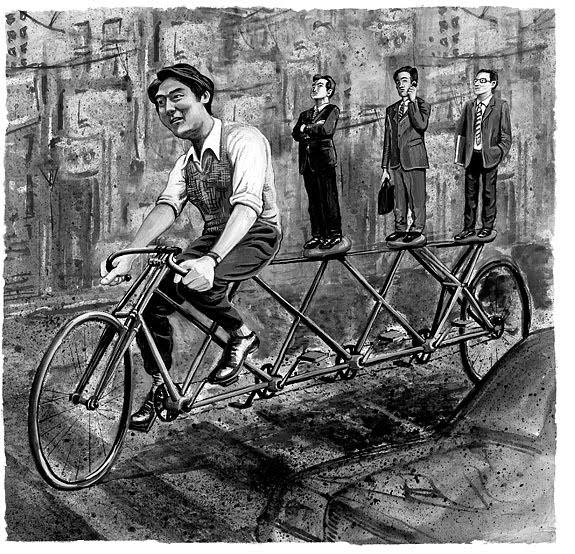
It's true, the last few drawings I've made seem to incorporate retro-looking characters (men with hats). These characters seem to embody the "everyman" concept, and are hopefully, just a "guy," rather than a specific type of guy (Hipster, Dad, Wall Street, etc)


4. I noticed that you work both in a pen and ink style that is very bold, graphic with bright digital color, but you also have a paintings section with a beautifully hand crafted rendered pieces. Do you have trouble promoting your work having two styles and do you favor one over the other?

I've heard from art directors that although they like the painted stuff, they can't see how it could be completed in time to meet their tight deadlines. That said, I'd love to do more paintings.


5. What is your process when concepting sketches for an assignment?

I start with words, then rough thumbnails. Sometimes I'll show the thumbnails to my studio mates and just ask, "what's happening here?" If they get it, it's a keeper and gets sent to the art director. I usually send too many ideas. Self-editing is not my strong point.


6. I’m aware that you just finished your MFA in Illustration from School of Visual Arts. Do you think that the program helped you become a better illustrator?

Definitely! It was two years of nothing but painting and drawing and thinking and talking about painting and drawing.

7. I heard from someone that you’re sharing a studio space with a few people. Could you tell me a little bit about that and why are you not just working from home?

Sharing a studio with other illustrators really forces you to stay busy and inspired. Also, working away from home allows me to "turn off" at the end of the day.


8. What’s your dream illustration job?

A series of Crime Noir book covers.

9. Were you rooting for any particular team in baseball last season? (I had my sights on the Phil’s by the way)

What's that? The Premier League, did you say? United for the cup!


10. What are some things that you love about illustration right now?

I really love the variety of styles. If you look back through an illustration annual from the 80's or 90's, you see amazing technical skill, but also a lot of styles defined solely on the medium used (super tight oil paintings, pen and ink crosshatching, collage, etc.). These days, mediums are blended together and the variety of styles is limitless.

11. Any advice for young illustrators breaking into the field?

That's me! A young(ish) illustrator trying to break into the field! Help!

----------------------------------------------------------

All images ©opyright of Andrew Roberts.
You can find more of his work at http://andrewrobertsillustration.com/

Big thanks to Andrew for taking the time to answer my questions.

-Daniel

11.11.2010

Sara Wood


-Where are you from and how long have you been illustrating and designing?

I'm from Chester County, PA and I've been illustrating/designing on a professional level since, uh, March of this year. I'm very green.

-Do you feel that U Arts prepared you to be a good illustrator/designer since taking on some projects?

Sure. UArts taught me to have high standards for myself and to always work hard, no matter what.

-I know when I graduated from art school, the economy just tanked, so our optimism was very low. When you graduated, what were your feelings when hitting the streets with things still looking a little dim but slowly getting better?

Well, I'm not sure that the creative job market is much better in 2010 than it was in 2009—especially for the crazies, such as myself, looking to enter the "dying" publishing industry, designing covers for "obsolete" bound books. This is why I've spent my daytime hours more or less as a temp since graduation, and am I ever grateful! A temporary job is better than no job, and while I'd love to have the peace of mind that comes with a full-time gig with benefits, I'm really enjoying the experiences that I've had thus far in the industry. I started off at Oxford University Press in June, and after getting used to the quick pace of academic publishing and the production process in general, I was asked to come and join Harper Perennial (an imprint of HarperCollins) in September as an in-house freelancer. The books at Harper are really fun and varied, the particular series that I'm working on is keeping me consistently challenged, the design department is top notch, and it feels like a great fit so far. Looking forward to whatever the future holds... It's all I can do!


-Your work feels very designed and has an old appeal while remaining fresh, which is very nice. Could you go into alittle bit of detail your process when working on a job?

Thanks... My process is a bit haphazard. Even in art school I never really had a "set" way of working. I've always used a variety of media, but my stand-by tools are my pencil (lately I've been using grease pencils as well), trace paper, my scanner, and a small library of textures that I bring into Photoshop. My work is most definitely a traditional/digital Frankenbaby. I like juxtapositions of smooth against rough, of lines that are refined against those that are just a little bit more spontaneous, and bringing my physical drawings into Photoshop gives me a great deal of flexibility for exploring that.

-So a while ago, you were working for Oxford University press as a designer, but now your working for Harper Collins. Could you tell me alittle bit about what you do there on a day to day?

I met the geniuses of Perennial (art directors Robin Bilardello, Milan Bozic, and publisher Carrie Kania) at a Portfolio Review event that they held at the Art Director's Club earlier in the summer, and after a few months of not hearing much, Robin asked me to come and work with them on a major project—80 titles by one of England's most famous authors. Most of the books already had cover designs that were being adopted from the UK, but those designs needed to be altered, resized, and in some cases completely redesigned. It's a massive undertaking involving many tiers of approvals, and when I'm not working on those titles or designing their promotional materials, I'm taking on mechanical designs (spines & back panels) and outside cover projects. I get to illustrate a lot, which is great.

-What's the best way for an illustrator to get their work infront of you and not piss you off as a book designer?

I'm no art director! But I work closely with the art directors and hear their complaints, so I can tell you that since office space is limited when you're designing 200 books per season, promos can really pile up. Make something that will stand out! Book people love to touch, open, and explore paper objects, so try incorporating even a slightly interactive element. A mini book, or an accordion-folded mini portfolio perhaps... So long as your promo catches the eye, invites the viewer to pick it up, and can fit tidily on an average-sized cork board, you're good.


-If someone was looking to become a book designer, what would they need to do to prepare, and where do you find out about where the jobs are posted for these in house design jobs?

First and foremost, you have to love books. Plain and simple. Read avidly, and when you go to a bookstore, jot down or mentally note the names of the people who designed your favorite covers. Also note when you see that a certain publisher seems to have a good number of beautiful designs. Research, research, research. The book design world is a very small one, and it's not too difficult to determine who is the Senior Art Director of this imprint, or Creative Director of that... Get sneaky, and once you discover that most businesses have an email naming convention like "First.Last@publishername.com" you can send personalized emails that say "I love your work so much! Here's a link to my portfolio site: etc." As far as in-house job opportunities go, my staple sources are bookjobs.com, mediabistro.com, and sometimes publishersmarketplace.com. Go ahead and join Design:related as well, if you can get an invite. That community is chock-full of people worth knowing if you're interested in book design (or any other sort of design).

- What do you love to do more, Illustrate and design book covers/posters or single images for publication?

Covers/posters definitely! Type has become such a tool for me, I miss it when I'm making a single image. Also, there's something about the practical application of book covers and gig posters that really satisfies me.

-What are you thoughts on digital tablets (ie: iPad, Nook, Kindle)?

I'm really not as afraid of them as some might think I ought to be. I actually had a brief conversation about this with Henry Sene Yee recently... He said that people will always need beauty. That really sums it all up, I think. Whether that beauty is printed on paper, or backlit on a screen, it doesn't matter. Apple has obviously recognized that fundamental truth with the iPad: its e-book app appears as a library of books displayed face-out on the shelf. While I will always have a deep-running loyalty to bound books, I'm not afraid of the fact that others might come to prefer digital media.


-After hours, what are you up to?

I often stay late at the office, which means that most of my "after hours" are spent sleeping, but I do work on freelance projects on top of my 9-5. Book covers mostly, but I also have a lot of fun doing gig posters for Redbird Management out in LA. I always have so much freedom, and I really relish the opportunity to scratch a creative itch or sometimes just create a beautiful image. Gig posters are just the best, aren't they?

-Goals/plans for next year?

1) Get a job with benefits!
2) Continue learning about my craft at my current momentum, and
3) Successfully plan my June wedding to Jim Tierney

-What are you loving about illustration/design right now?

The increasing union of the two! I love seeing illustrators try their hand at type, just as I love seeing designers try to draw their own imagery. I think people our age and current students are doing a great job of bridging the gap between the worlds of illustration & design.


-Advice for young illustrators trying to get their start.

The internet is your bestest friend! Get a website, start a blog, join Flickr, get a tumblr, join

Design:related. Branch out your web presence, and it's amazing who will find you, and in turn, who you will find. Gobble up inspiration from your blog feed and keep yourself informed. It's amazing how lucky we are to have this tool these days... It almost makes up for the horrible economic conditions we're contending with.

-Advice for the veterans?

God no! Oh wait, here's one: please teach me more.

-Final Word?

Preflight.

-----------------------
Thanks again Sara!

You can find her work here: www.sara-wood.com

and she has a flickr with alot of other stuff too: http://www.flickr.com/photos/thewoozle/sets/72157603425545381/

All images copyrighted Sara Wood

10.05.2010

Jude Buffum


Hello Everyone! My name is Daniel Fishel, and I am a new contributor on the non-slick blog. Before I get into the interview, I want to give a big thank you to Pete Ryan for inviting onto the blog. My goal is to do at least one interview a month if not more, so we will see what happens.

1. Where are you from and how long have you been illustrating?

I moved around New England a bit when I was much younger, but I've lived in Philadelphia most of my life and currently reside here. I graduated from the Tyler School of Art in 2001 with a BFA in Graphic Arts and Design, but I was mainly doing graphic design at first. It wasn't until late 2002 I really started working on any illustration only projects when I was a part of Headcase Design. At first illustration made up only about 20% of the work I did, graphic design being the rest. By the time I left Headcase in October of 2007, nearly all the work I did was illustration.

2. What drew you to paint your images with Pixels?

Initially I just wanted to create some nostalgic artwork to hang in my apartment, so I experimented with blowing up "sprites" of characters from old video games I played when I was a little kid, enlarging them until each pixel was a full inch square. It was around this time I was becoming increasingly frustrated with the state of our country (this was right around when we first invade Iraq) and so I began experimenting with using the video game style as an outlet to vent. Instead of Megaman fighting Dr. Wily he was fighting Dick Cheney and Haliburton. It was through these early political-themed pieces that I realized the language of video games and pixels are rich with infographic metaphors, digital mythology and graphic symbolism that could be used to express almost anything I wanted.


3. You have a second style that still feels like the language you draw in, but it is a slicker illustrator version. Do you have problems with clients because you have two styles?

Generally most clients come to me knowing which of my two styles they want. I do prefer the pixel style, so there have be instances where I felt the pixel style would be stronger and I was able to convince them I should use that one instead. It gets a little tricky with self-promotion, deciding which style to focus on promoting. Generally I send out postcards with the pixel style, and that's the one I tend to get into annuals more frequently, but I do get a lot of work in the infographic style still.


4. There are some illustrators that happen to also be designers and include type in their work and there are some designers that just happen to also illustrate, but neither seem to have a balance. I find that in your work has an good balance of using type within pieces that could just be single image for a publication/gallery. Do you think because you work within the language of video games/8bit that allows you to do it, that seems pretty effortless?

I was trained as a graphic designer, but Tyler has a fairly illustration-heavy design program, so I have always tried to illustrate my design projects when possible. I think with the pixel style, pixelated type and pixelated art will naturally fit together, but that doesn't mean they will necessarily be aesthetically pleasing. On the contrary, I think there is a certain ugliness to pixel art and type that some people actually don't like, so I think the type forms need to be carefully constructed and considered.


5. I know that you've done some music packaging stuff for your brother's 8-bit jams, Doctor Octoroc. Do you ever collaborate musically? Also, how did the Keyboard Cat video come about?

While I wouldn't say I collaborate with him musically, he does play me all his tracks as he's working on an album and lets me offer my feedback. The Keyboard Cat video was something we did on a whim. I thought it would be funny to do an 8-bit version that played off a game fail, so we threw it together one afternoon and put it on youtube. I never thought it would blow up the way it did. The main character from the show The IT Crowd even wore the shirt I made from the video on a recent episode.


6. About a year ago, you worked on an installation at the 3rd Pictoplasma Conference, making 8 bit creatures on the walls with thousands of post it notes. How was it that you were able to get involved in such a project?

Jon M. Gibson, who founded the "i am 8-bit" art show, was the guy who really helped me get my foot in the door with a lot of the galleries I've been involved in. He actually found me through Myspace (remember that?) of all things. It's a long story, but after several years of working together on gallery installations he contacted me about the Pictoplasma thing. His good friend and photographer Love Ablan had been asked to put together an exhibition by the founders of Pictoplasma. Exhibitions of art on Post-Its were nothing new, and other people had created Donkey Kong or Pac-Man installations out of Post-Its, so we decided to take it to the next level and create original pixel art out of Post-Its and then have art on Post-Its hidden within that, an exhibition within an exhibition. I actually got a grant from the University of the Arts to do the whole thing.

7. Recently I have been seeing you work more and more doing Gallery stuff. How have you been getting involved with that, being someone who works digitally?

I do occasionally paint my work in acrylic, but given that my fan base is a younger crowd I try to make my work affordable so giclee prints from digital seems to be a better deal for everyone. As long as the work sells, most galleries don't seem to mind the medium.


8. What is your process when concepting sketches for an editorial assignment?

You'd think by now I'd have a process. I really don't. I throw shit against the wall and see what sticks. Swear.
Nate Williams posted a great idea generation process on his blog that I will sometimes use when I'm at a loss.

9. I know that you teach a class or two at The University of the Arts. Could you share alittle bit what you teach there and has teaching there influenced the way you work?

I'm currently taking some time off, but the course I teach at UArts is an Illustration class called "Design Methods". Basically what I do with each project is assign the students the role of illustrator AND designer/art director. So for one project I give them several magazine articles and they not only have to illustrate the article, but design the layout of the spread as well. A project that I introduced to the department has them designing a vinyl toy (like Kidrobot) and then creating packaging for the toy. It's a very demanding project, but they have so much fun with it and the results are usually phenomenal.


10. Outside of illustration and galleries, what is it that you do when you have down time?

Karaoke, bird watching, cooking, barhopping, road trips, fixing vintage Polaroid cameras, and playing with my Boston Terrier

11. I've noticed a lot of well known/successful illustrators, such as yourself, Josh Cochran, Gina+Matt, Katherine Streeter, Pete Ryan, ect, all own Boston Terriers! Is there a skull and bones club for illustrators that requires everyone to own one?

I think there must be something in illustrator DNA that draws us to the Boston Terrier! I swear I got mine before I even met any of those guys, and in fact the only person I knew who had one when I got mine was a friend of mine who is a floral designer. I guess they go through phases of popularity... if you look at dogs used in advertising in the 1950s, they used Bostons quite frequently. I guess they are on an upswing in popularity again.


12. Because you work digitally, specially in adobe illustrator, it makes your work more adaptable for interactivity and animation for tablet devices (ie: ipad, Nook, ect). Are you investing time into interactivity and animation because of a rising interest in tablet devices and/or do you have an opinion on illustrators becoming more involved with animation/interactivity?

After the keynote at the ICON conference in Pasadena, I became very excited about the possibility of creating interactive and motion illustration for devices such as the iPad. I do plan on investing some time in the next six months to learning as much about the subject as I can. I see it as just another industry, so I don't really see what all the fuss was about. Some illustrators will want to add animation to their portfolio. Others will want to add textile design. Or food packaging. Or fine art prints. It's all the same thing, just different avenues to make a living off what you love to do.

13. What are some things that you love about illustration right now?

I love that there are really no limits as to what you can do with your art. It's interesting to watch the many careers of all of the illustrators I admire, or know personally, and see where they started and where they are now, and there's so much variation it really shows you can do anything in this field.


14. Any advice for young illustrators/designers breaking into the field?

Personal work is good, but if prospective clients can't see how it could be used commercially they're not gonna hire you. If you're not getting jobs yet, or jobs that bring out your best work, create your own assignments (a good example would be the Heads of State creating concert posters for the local Philly music scene). Make them amazing and get them into Communication Arts and American Illustration.
Personal work for gallery shows are important too, but it's much harder to make a living at that, and I see way too many kids out of school focusing too much energy on that avenue and it's a long, uphill battle. Don't spread yourself too thin.

15. Any advice for the veterans out there?

Anyone who's been doing this longer than me is obviously doing something right. I could probably use advice from them.
That said, don't fear new things. Twitter and Facebook are amazing tools for advancing and sustaining your career. My biggest break into the gallery world came from MYSPACE. Yeah. And Myspace was a piece of crap compared to what Twitter and Facebook can do. If you think it's just some stupid way to share what you had for breakfast with the world, you really have no idea. Reach out to those in the know.

16. Final word?

Game Over

---------------------------------

All images copyright Jude Buffum - See more of Judes work on his website: http://www.judebuffum.com/
Thanks Jude!